mutteringhousewife

Adventures in cooking, travel and whatever else I feel like musing on

Mandarin Syrup

I haven’t done a syrup for a while, have I? At least, that’s what the kids tell me. I like to make syrup out of any fruit that’s cheap and plentiful, and at the moment that’s mandarins.

It’s a pretty simple one. I was inspired to try it because the a Thermomix recipe book had a recipe for Mandarinade. I made it. It was just awful. I tossed it in the compost. Don’t bother trying it. Here’s what you do instead.

Boil up two cups of caster sugar with a cup of water. You can do this in the Thermomix, put it on 100 degrees, speed two for about seven minutes. Then take six mandarins and two limes and skin them.

20130503-164312.jpg
I put them in the blender and zapped them good. Put the steamer basket in the Thermomix jug and tip the citrus pulp in. Squash it down with a teaspoon to get all the juice out. Or just strain it into a bowl if you’re doing it the old fashioned way. You should get about 250 grams of juice. Zap it on speed four for a few seconds to mix it in. Now you should taste it, because there’s a fair bit of variability in the tartness of the fruit. Mine was a bit sweet, so I stirred in a teaspoon of citrus acid.

I then strained it into a jug, I like my syrup clear. You don’t really have to.

20130503-165040.jpg
You add it to soda water, don’t drink it straight unless you’re trying to mess with your blood sugar. The German billet liked it better than bought lemonade. So there.

Phone Rant

We’ve all got at least one phone rant in us. This is mine.

It all started several years ago. A kind relative gave the Muffet a mobile phone, as she’d be travelling to school by train. The problem was the provider. Vodafone. Apparently they’re very good if you happen to be standing under one of their towers, but don’t think you can call your parents from pony camp. Or from inside a building. The other thing about Vodafone is that they lock their phones so you can’t get a different provider. They do provide a method for unlocking the phone, which I followed to the letter. It didn’t work. I went up to a Vodafone shop and explained my dilemma, and you can imagine that they were of no use at all. There was an option that involved posting the phone to Tasmania at my own expense, but that wasn’t for me. As my nostrils started to flare and my voice got softer I noticed the manager sidle into the store cupboard. No, really. The woman trying to help me leaned forward and said “you know, that guy that sells phone cases downstairs hacks phones to unlock them. Your best bet is to go to him”.

The hacker downstairs said his services were too expensive for a basic phone like this, I should just buy a new phone from Telstra. I did just that. The Muffet lost it almost immediately.

The second instalment came when another kind relative gave the Muffet a Galaxy that had become surplus to requirements. I don’t know what it is about the Muffet, I think it’s the blonde hair. And she’s very charming. I immediately opened up the phone and was relieved to find an Optus SIM nestled in it. All I needed now was a Telstra prepaid pack and we were communicado again. I went up to Woolies and asked for a prepaid SIM pack. “Nah, love, we only do recharges” said the friendly lady. “Would you care to turn around and give me that pack behind you that says “Telstra prepaid SIM card starter pack? No, not the nano SIM. Regular. It’s orange.” We got there in the end.

No, it didn’t work when I inserted it and followed the activation steps. Two phone calls to the help desk resulted in a lot of Indian accented humming and hawing and finally a suggestion that I take it into a Telstra shop. The Telstra shop also did some humming and hawing and finally asked “are you Alexis Henderson of Castle Cove?”. No, I’m not, and neither would I have lent Muffet’s phone to him if I had ever met him. Well, at least I got to deal with the actual manager, and he was kind enough to say he’d never come across this problem before. You know how he fixed it? Just redid the activation. “Ah”, I said. “The help desk effect”. “You’re familiar with it?” “Oh yes, I used to be a help desk”. “We’ll, I don’t know why it worked, but thanks for showing me a new problem”.
Anything I can do to help. I just love spreading sweetness and light.

20130502-164637.jpg

Passionfruit Icecream in the Thermomix

I have to go pick up the German billet in half an hour, and instead of trying to disguise the fact that the house looks like it’s been violently burgled I’m telling you about passionfruit ice cream. At least I’ve made her some Anzac biscuits, I’m pretty sure that’s what any German billet would expect upon arrival. Followed closely by a Vegemite sandwich and a ride on a kangaroo.

It wouldn’t have occurred to me to attempt to make ice cream Before the Thermomix. I couldn’t find a passionfruit ice cream recipe that removed my socks either so, as I’m a veteran of one ice cream production, I thought I’d make it up.

I didn’t want one with seeds in it, and I find the act of sieving passionfruit frustrating and disappointing. So I did something I’d worked out when making syrups, you boil the pulp with a bit of water and sugar. I find I extract more passionfruity goodness that way.

Take quite a lot of passionfruit. I had a net full, but then we ate some, so it ended up being eleven. Scrape the pulp into a small saucepan. Add one hundred grams of water and three hundred grams of sugar. After tasting the custard I thought that might be too sweet, but in the finished product it’s fine. You could probably get away with 250 grams.

20130501-145056.jpg
Put it over a small burner and bring to the boil, stirring to help dissolve the sugar. This took me about five minutes. Take it off the heat when it looks like it’s trying to escape.

20130501-145148.jpg
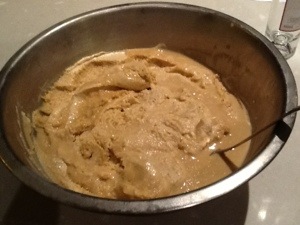
Insert the steamer basket into the Thermomix jug and tip in the syrup. Squash down the pulp with a teaspoon, you only want seeds left. Discard the pulp. Add to the jug three hundred grams of cream and two hundred grams of full cream milk. You could go all cream if you want it very rich. I also added a pinch of salt. Zap it on speed five for thirty seconds to mix. Reduce the speed to four and crack four eggs through the hole in the lid. A tip here: if you do get a little cocky and manage to drop half an eggshell through the hole too, you can stop the machine and retrieve the unbroken shell if you’re quick. Replace the measuring cup in the lid, set the temperature to ninety degrees and continue on speed four for five minutes. Pour the custard into a metal bowl and shove it in the freezer.

All the recipes I see suggest three to four hours in the freezer will do the trick, but not my freezer. More like overnight. Anyway, once it is frozen, and this could be days later, scoop it out of the bowl and back into the Thermomix. You can see why you need this step if you look carefully at this photo.

20130501-145957.jpg

See there’s a creamy lay on top and an icy layer underneath? That needs breaking up.

20130501-150041.jpg
General Thermomix icecream instructions now tell you to mix on speed nine for twenty seconds, then speed four for ten. You are going to need to poke it about with the spatula, it’s pretty stiff. I think just zap and poke and zap and poke until it looks entirely broken up. It will be about disgusting McDonalds icecream consistency at this point, so pour it back into the bowl and back it goes into the freezer.

20130501-150335.jpg
Should be ready for dessert. I’m going to be serving our billet for dinner that Australian classic, spag bol. Passionfruit ice cream should go nicely with it. I hope the kookaburras are back in the morning, that’s the kind of thing she would have signed up for.

Raisin Bread in the Thermomix

I know you were all dying to hear about how the Verdi went. I’m feeling a bit conflicted about it. On one hand the orchestra and choir were superb, apart from that bit where my friend and I came in two beats early. Hopefully only the tenors in front of us noticed, but they’ve assured us they’ll never let us forget it. On the other hand the tenor soloist may need surgery. So I’m going to tell you about raisin bread instead.

I’ve just got the third loaf of raisin bread this week out of the oven. My kids have only started eating my bread since I’ve been making it in the Thermomix. I think it does a much better job of kneading, as I get bored very quickly, which means that it rises properly. I’ve also invested fourteen bucks in a high sided loaf pan as it sometimes droops over the sides of the smaller one, giving a slice that doesn’t quite fit in the toaster.

I’m weighing the yeast on a conventional scale because I don’t really trust the Thermomix scale for twenty grams. It’s a bit blasé down that end. So weigh out twenty grams of fresh yeast and bung it in the jug. Add a quarter of a cup of sugar, half a cup (or 130 grams) of buttermilk (my new favourite bread making ingredient) and a cup (or 250 grams) of water. I like to give it a five second zap at this point to mix all that together. Add two teaspoons of mixed spice and six hundred grams of flour. Zap it for about thirty seconds on speed four or until it looks like it’s trying to escape through the lid. Then you put it on closed lid position and press the interval setting and have it go for three minutes.

Pull it out of the jug and place it in an oiled bowl. Cover it with a tea towel and stick it in the oven with the light on. When it’s doubled in size, knead in half a cup of currants and half a cup of sultanas. Place the dough in a lined loaf tin.

20130429-182404.jpg
I’m actually using golden raisins until I can get back to Honest to Goodness and get some of their delicious sultanas. Poke those suckers in, they try to escape. Put it back in the oven with the light on until you can see the loaf rising over the top of the tin.

20130429-182639.jpg
Brush the top with milk and sprinkle with cinnamon sugar. Bake for ten minutes at 220 degrees, then turn the oven down to 180 degrees for another thirty minutes or until it’s all brown and delicious looking.

20130429-182928.jpg
That’s breakfast sorted.

Back on my Feet

Many of you will know I have just gone through the fairly minor, in the scheme of things, inconvenience of having my foot in plaster for six weeks and therefore having to get about on crutches. Goodness me it’s been an interesting six weeks. Here are some of my observations.

The first is that I must have heard from every single person in the Inner West that has ever injured themselves on the lower leg. Or knows someone who has. If I ever see anyone on crutches, no matter how curious I am, I shall just mutter “tough luck” at them and move on. I have in the past had a giant neck wound, jaw to collarbone, and had no one say a word, just a horrified flick of the eyes. But someone on crutches seems to be just holding a sign saying “I’m not moving fast, so tell me all about how much better European crutches are, how long it is since your knee reconstruction, what a dangerous sport rugby seems to be, how terrific online supermarket shopping is these days (it isn’t), and how exactly your grandmother fell down the stairs”. It didn’t bother me too much, besides the unwanted human contact (character building), but I found it to be a fascinating insight into sociology. I guess because it doesn’t look life threatening and in general people want to connect, so that’s nice. I just wish the explanation of my injury could fit into one sentence, or could be printed on a small card.

My blog has come up as a suggestion for someone asking the question “how do you shower with your leg in plaster?” and the answer is that you do it on one leg. Try it some time, it’s a lot harder than it sounds. It’s also the answer to “how do you cook dinner”, “how do you use stairs”, “how do you feed the cat” and “how do you get the kids out of bed” with your foot in plaster. Actually, stairs are the worst. I can now hop down them, but the only way to get up them with your foot in plaster is on your hands and knees. It’s quite a spectacle. Also, feeding the cat on one leg results in a cat with rather a lot of kangaroo meat on his head. He didn’t seem to mind. I’m sure the kids will be relieved to be woken up with the traditional pat on the head rather than crutches to the solar plexus from now on.

The thing I have missed the most this last six weeks is being able to carry things. Any good housewife will tell you that you don’t walk anywhere in the house without something in your hand, clothes to put in the wash, rubbish, a bottle of water to tip on the head of your barking dog. There has been none of that. Anytime I wanted to fetch something I’d have to do it with a handbag around my neck, which doesn’t work for a cup of coffee or a glass of wine, let me tell you. The biggest impact was that I wasn’t able to put on a wash. So I’ve had to put up with no separated washes and everything going in the dryer – it seemed to be enough of a strain on everybody to have to deal with this daily task without me shouting at them that they weren’t doing it right. The first thing I did when I tottered home from the sports doctor with my freed foot was to get myself a takeaway coffee and put on a dark wash, which is now hanging in the sunlight. I may even go soak some tea towels in Napisan in a moment.

It is going to be a bit of an effort not to get out and rejoice in the return of my foot, but I’ve used up my physio on my health insurance for the year, so I’d better take it easy. There is a noticeable difference in the sizes of my calves, but the doctor assures me that will return to normal fairly quickly, especially as I won’t be hopping any more. I think I shall go and hunt for all of my right shoes, that shouldn’t be too taxing.

20130426-125844.jpg

Neil Perry’s Prawn Wontons in the Thermomix

Just so you don’t roll your eyes, this one can also be done in a blender. No matter what you think of his ghastly hairdo, Neil Perry can certainly give you a fair indication of what should go into a wonton wrapper and he shared a tasty looking recipe in this week’s Good Living which I immediately sucked into my recipe app. I don’t really have my Asian palate going yet, so I’m still taking fairly careful direction on ingredients.

First you collect your ingredients. I put the following in the Thermomix, two cloves of garlic, a tablespoon of dark soy sauce, a teaspoon of sesame oil, a centimetre of sliced ginger root, an ice cube of coriander chopped, a green onion chopped, about ten centimetres off the end of a stale bread roll and a pinch of salt. I zapped it to form a paste. Then it was suggested I add a one hundred gram tin of water chestnuts. I had a two hundred and thirty gram tin (which I actually had to open with a can opener!), but when I weighed the chestnuts they came to about a hundred and twenty grams, so put all of that in. Also put in three hundred grams of frozen green prawns, I really must thank Daniela for making me buy a kilo bag of frozen prawns, it has been so handy. The Thermomix made short work of that, but unless you’d like your blender to take a short holiday back to the land of warranty you may wish to defrost the prawns first. I only put it on speed five for about twenty seconds, I didn’t want a mush.

20130424-191324.jpg
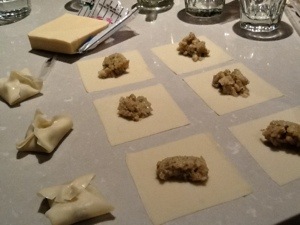
I happened to have a packet of Double Merino wonton wrappers in the fridge. I wonder what they mean by double merino? Twice the sheep? Anyway, despite the packet saying contains forty wrappers, only thirty two transpired, meaning either I’m not very good at peeling them off, or they’re selling them by weight. Thirty two was the perfect amount for a heaped teaspoon of filling each.

20130424-191543.jpg
Neil Perry suggests moistening the edges of the wrappers with egg whites before pressing them together. I think this means that he has a kitchen full of slaveys, so I just went with fingers dipped in water. I got a kind of technique going in the end.

20130424-191723.jpg
It only took about twenty minutes to fill them all, maybe less, I had a phone call from my in laws in the middle of my production line. Now the question is how to cook them?
I’ve only got two options open to me at the moment, as I’ve run out of spray olive oil. I tried frying them first in peanut oil. I generally don’t do this because I never know what to do with the excess oil afterwards. I shall try pouring it on the annoying weeds that infest the side of the house.

20130424-192916.jpg
They kept their shape and were cooked through and pleasingly crunchy. I thought that the filling was a little delicate for this kind of treatment, so I had a go at boiling them.

20130424-193034.jpg
They’re not terribly visually appealing this way, but I like them better. I think the best way would be to spray them with oil and bake them, so I’m storing most of them in ziplock bags for another time. I feel like it could have done with a little more prawn, so next time I might increase it to five hundred grams (and make sure I have enough wrappers), or reduce everything else. The biggest surprise was that they didn’t fall apart with either method of cooking, they really make those wrappers tough and are clearly made for people who don’t have kitchens full of slaveys, but can only dream about it.

In Defence of Classical Music

The Moose is studying electronic music at school which has resulted in not so much a discussion about music, rather just me giving him a diatribe about how very very much I loathe and detest and abhor that garbage.  “But Mum”, he said.  “Electronic music was a revolution.  It meant that people with no musical training or skill were able to make music”.  He may have touched the heart of why it’s so crap.

My testiness has increased because the greasy young man that lives next door is rather fond of electronic music,  which has enabled me to pinpoint exactly what it is about it that irritates me so much.  It’s the repetition.  Doof doof doof derdoof, doof doof doof derdoof, for four, eight, sometimes sixteen bars with only minor variations over the top.  Some may find that soothing or hypnotic, especially if they’ve suffered a traumatic injury to the brain stem or are on a certain class of drugs.  It affects me like a tiny flying chainsaw trying to very rhythmically escape my skull from the inside.  It makes me want to smash things.  Like next door’s sound system.

I will agree that classical music can be a little inaccessible, and there is a reason for that.  The kind that you go and hear in a big venue is very complicated.  It has been written by men (generally, there’s a whole other discussion) who have studied music for years and been immersed in a classical music culture often since birth.  It can only be performed by musicians who have dedicated much of their lives to training on their instrument.  Listening to it takes commitment.  If you are planning to go to a classical music concert, and like all music (except electronic) it’s better live, listen to the pieces first a few times.  The first listen will be a big blah of louds and softs and you won’t like it a lot.  Gradually the patterns and the shape of the piece will become apparent.  Then every time you hear it performed you’ll find something new in it and it will totally capture you.

My theory is that the kind of music most people listen to needs to be turned up loud because that’s the only way you’re going to be able respond to it – if it’s actually making your head vibrate.  If you’re listening to classical music your brain will be so busy following the melodies and counterpoints and dissonances and filigree that you can be engaged with it without having to annoy the neighbours.  Most popular music is like junk food.  Easily consumed, easily forgotten.  There’s a place for it in your diet, but if that’s all you’re eating you are missing out on those ten course banquets that are the classical canon.  Yes, you’ll need to educate yourself a bit to appreciate it, but it is so very much worth it.

My favourite way to interact with classical music is to be involved in a performance of it.  My choir (Sydney University Graduate Choir, click here) is performing Verdi’s Requiem next Sunday at the Sydney Town Hall at 3pm.  Google it, you definitely will have heard the second movement.  We’ve been practising it for months, and we’re now in my favourite bit where I know the piece so well that it is swirling within me all the time, not so much an earworm as an entire worm farm.  I can’t imagine how my conductor must be feeling, he has to get to that point before we start rehearsing, then spend a few months extracting from us what he’s already hearing in his head.  On Sunday I’ll be one of a three hundred strong choir, contributing my voice to a piece that is sometimes sung in eight different parts, sometimes in a gentle intense unison, sometimes screaming hellfire, sometimes a delicate lullaby.  I can’t wait.  If you can get there, book a ticket now (Ticketek and Seymour Centre), there are a few seats left.   It will be an amazing experience for the audience, but even more so for the musicians.

Buttermilk Bread in the Thermomix

I have finally made a bread that the children will eat. I’m pretty good at making a worthy bread, all dense and full of seeds and activated currants and what have you. But my white bread also has traditionally come out a bit worthy, dense with a very crunchy crust. The kids just refuse to eat it. Even if it’s the only bread on offer they’ll eat almost anything else, corn crackers, cucumbers, expiring grapes, seaweed. But this bread came out light and fluffy and everything they’ve ever wanted in a bread. I’m not sure where they acquired this bourgeois taste in bread, but I may have to cull their friend lists.

It’s a recipe straight out of the Thermomix cookbook and I didn’t even tweak it much. Place in the Thermomix 180 grams of buttermilk, 200 grams of water, 20 grams of fresh yeast, a couple of turns of the sea salt grinder, 500 grams of flour and 10 grams of oil. I think the reason they put buttermilk in a few of their recipes is because you can actually make your own butter in the Thermomix, and you have buttermilk left over. You’d better believe it’s on my to do list.

Put the lid on and mix for five seconds on speed 7. Yes, it does sound a little arbitrary, doesn’t it. Set the dial to the closed lid position and knead for three minutes on Interval speed. And that’s one of the many annoying things about this recipe book, the basic white bread recipe calls for half that kneading time. A focaccia recipe (seriously, is anyone making focaccia? Where’s the Turkish bread recipe?) gives a two minute knead time. Inconsistent.

The dough is very sticky, I floured my hands before scraping it out. Place it in an oiled bowl and leave it in the oven covered with a damp tea towel with the light on for about half an hour, until it has doubled in size. Sling it into a lined loaf tin and back in the oven with the light on. I don’t cover it at this point, because I like to hop past and see how it’s going. This loaf rose a lot more than my white bread usually does. I baked it at 180 degrees for about forty minutes, you tap on it when it looks brown and it should sound hollow when done. Just look at that crumb.

20130422-123421.jpg
I baked it yesterday afternoon and it is still soft and delightful today, another win over my usual recipe which goes stale almost immediately. It makes an excellent piece of toast.

20130422-123539.jpg
One of the many things the kids have against home made bread is that they have to cut it themselves. It’s almost like living in the salt mines of Siberia, such a heartbreaking amount of manual labour. It’s got to be a good sign that even the Horror from Outer Space is chopping off chunks of it and eating it unadorned. “How is it?” I ask him. “I guess it’s OK”, he said, spraying me with crumbs. Praise indeed.

Thermomix Caramel Icecream

“You know,” I said to the Horror from Outer Space as we sat companionably at our local, The Hungry Grasshopper. “I can make ice cream in the Thermomix”. “You should make caramel,” he said, looking up from his caramel milkshake. “Not long ago you could only get strawberry, vanilla and chocolate milk shakes. Caramel is making a comeback”.

Well, it is one of my favourite flavours too. I like to do my research first, and there seems to be a canonical caramel ice cream recipe for the Thermomix, the Salted Caramel Maple Syrup ice cream recipe. I had a big lurk in the forums, and there were opinions on the saltiness, the sweetness, the richness of this recipe. I took all of these into consideration and came up with the following.

First, you make the caramel. Put 250 grams of brown sugar into the Thermomix and zap it on speed 9 for thirty seconds. The recipe actually said raw sugar, but I didn’t have any. The forums also suggested rapadura, but I don’t know what the hell that is, but filed it away with aged rice as something to investigate for the future. Add 50 grams of maple syrup, 50 grams of unsalted sweet butter and two teaspoons of vanilla extract. I checked back to very original recipe and it said two teaspoons of vanilla bean paste, which is a bit more intense and I did happen to have it, so that went in. Put the Thermomix on Varoma temperature, whatever that is, and cook it on speed 1 for fifteen minutes.

Then you add either two teaspoons of sea salt if you do actually want it salty, or a couple of grinds of the salt grinder if you don’t really, or you don’t have an over salted palate. Have a guess which way I went. The recipe also suggests 500 grams of cream and 100 grams of milk. Looking at the number of forum comments suggesting it was a very rich recipe, and looking at the vanilla ice cream recipe in the included recipe book, I went 210 grams of cream and the rest full cream milk (ie 390 grams). Beat on speed five for thirty seconds.

With the beater still going, reduce it to speed four, then crack into the hole in the lid four eggs, one at a time. Once again taking the advice of the forums, cook at speed four at ninety degrees for six minutes. That’s your custard, pour it into a metal bowl and bung it into the freezer.

Apparently after about four hours it should be firming up. Mine is just going frosty about the outside, but once it’s relatively firm you spoon it back into the Thermomix and zap it on speed 9 for thirty seconds. The idea is to break up any ice crystals that are forming, a smooth mouth feel is caused by very tiny ice cream particles. I think you could probably repeat this step until you get a desirable consistency, but from what I can see once should be enough. Everyone has had a taste and it does seem that it may all be gone by breakfast time. The complexity of the flavour can be demonstrated by the husband’s question which was “does it have coffee in it?”. It doesn’t taste burnt, but the flavours have blended so that you can’t pick one out. I wouldn’t have picked that it had quite a bit of vanilla in it.

I am somewhat tempted to spoon it into the iceblock moulds while it’s still sludgy, but for this experimental run I may desist. It is taking longer to freeze than suggested, but the numerous tastes that have been taken have reduced the volume somewhat so that should speed it up. I like the adjustments I’ve made to the canonical recipe, my family’s palates aren’t ready for the extra salt and I think the full complement of cream would have been too rich. I am rather excited by the plethora of possibilities opening up now that I can make ice cream. Not that I eat ice cream, oh no.


20130419-212522.jpg

Roasted bits of Goat

I’m taking advantage of the absence of the Muffet to cook one of the many species she objects to us eating. Actually, I’m not sure how she’d feel about this one, having a bit of a hate hate relationship with the goat that resides at pony camp where she spends as much of her holidays as she can. He’s one of those narrow eyed goats that likes to sneak up on horse mad girls and butt them in the butt, then retires to snigger into his beard. Eating him may be taking revenge too far for her.

My favourite butcher stocks goat, and not only that, it’s all chopped up into manageable sized pieces and lavishly marinated. Actually, hacked up may be more accurate, in the kilo bag I bought today there were all varieties of rib, a chunk of thigh and what may have been a bit of rump. Perhaps they’re training their apprentices on the goat. I’ve been trying to pick what’s in the marinade, I could see dates and dried apricots and pine nuts and I’m guessing olive oil and a Moroccan spice paste. Half the price of the lamb, so I’m not complaining.

They suggested slow cooking the goat, and it’s getting to be that kind of weather. I packed the pieces into a frying pan and browned them first.

20130417-183437.jpg
Then I put then in a roasting pan and covered it with foil. That went into the oven on 140 degrees for two hours, then I turned off the oven and let it sit for an hour.

You have to know your audience. This will be consumed by a man who has just come in from an hour and a half of coaching soccer to twelve little boys who haven’t seen each other for days in the dark and cold with the wind coming straight off the bay. He doesn’t want to muck around picking fragments of meat off bits of bone and sinew, he want to shovel it in while it’s hot, preferably accompanied by a large glass of red. So I picked the meat off the bones, and there was more than I expected.

20130417-183806.jpg
It’s only by an iron exercise of will and a handful of cooking chocolate that I can stop myself from a fairly large scoff of this stuff, it’s delicious. Dark, tender, flavoursome. Not gamey, more like a beef shank or cheek than anything I can think of. I was planning to serve it with couscous, spinach and feta, as being culinarily related, but it’s too salty to put with feta, so I’ll leave that for another day. Not that I usually mess with presentation, but I think if I cook the couscous, then stir through some baby spinach and diced red capsicum at the last minute with the reheated goat on top it will look rather appetising.

20130417-184413.jpg